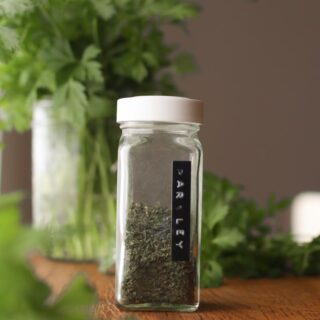
How to Dry Parsley 3 Ways
Learn how to preserve parsley with 3 easy drying methods.
Equipment
- Salad spinner
Ingredients
- Fresh parsley
One of the following:
- String and rubber bands
- Baking tray and parchment paper
- Food dehydrator
Instructions
Oven Drying
- Remove excess stems from the parsley and spread the leaves out in a single layer on a parchment paper-lined baking tray. Alternatively, you can place an oven-safe cooling rack on a baking sheet and arrange the parsley on the rack to enhance airflow for even drying.
- Preheat your oven to the lowest temperature setting (I set mine to 180°F) and put the tray of parsley inside. Keep the oven door slightly ajar using a wooden spoon to allow excess moisture to escape and promote drying.
- After 30 minutes, inspect the parsley. It should be dry and crispy but not brown. If the leaves still feel pliable or moist, continue drying them for more time. Check the parsley leaves every 15 minutes to avoid overcooking.
- Once the parsley is thoroughly dried, take it out of the oven and allow it to cool completely. Strip the leaves off of each stem and crush them before storing.
Air Drying
- After rinsing and spinning the parsley, gather it into small bunches, tying the stems together with a rubber band.
- Hang the bunches of parsley stems in a dark place out of direct sunlight. Ensure proper airflow between bunches and avoid hanging the bunches up against a wall.
- Allow the parsley to hang until dry and crunchy, usually around 2-4 weeks.
Food Dehydrator
- After rinsing and spinning the fresh parsley, cut off excess stems and lay the remaining parsley sprigs out onto dehydrator trays.
- Set the dehydrator to a low setting (around 100°F) and place parsley in the dehydrator for 8 hours. Drying time will vary based on a number of factors, but the parsley should be checked regularly after the eight-hour mark.
- Once the parsley leaves are dry and brittle, turn off the dehydrator and allow the parsley to cool to room temperature.
- Strip the leaves off the stems and crumble them into small bits before packing them away for storage.
Tried this recipe?Let us know how it was!